The Objects of Lesbian Artists in Korea
(2022)
/ Jeong Lee (Artist)
︎︎︎Full text
(•••)
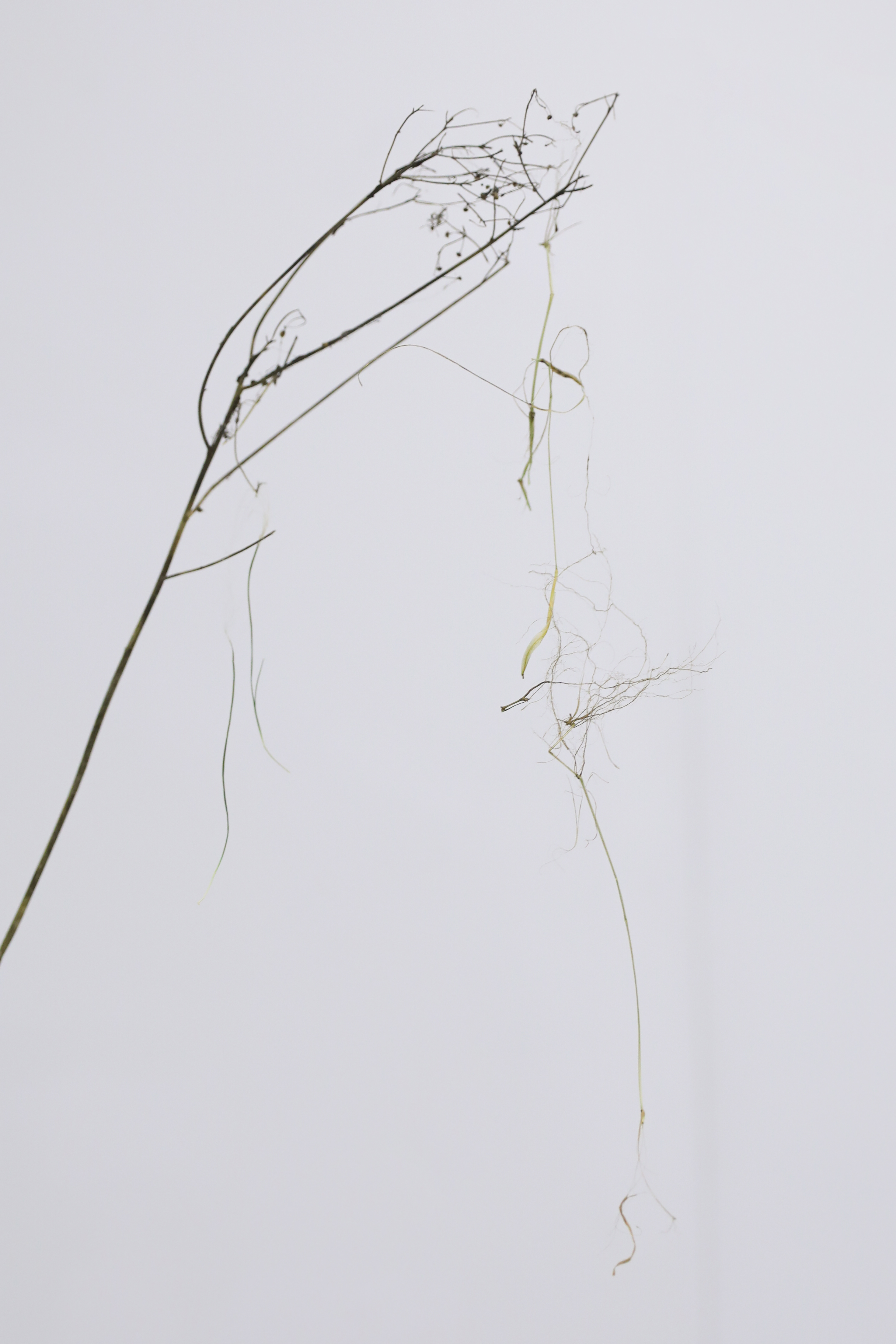
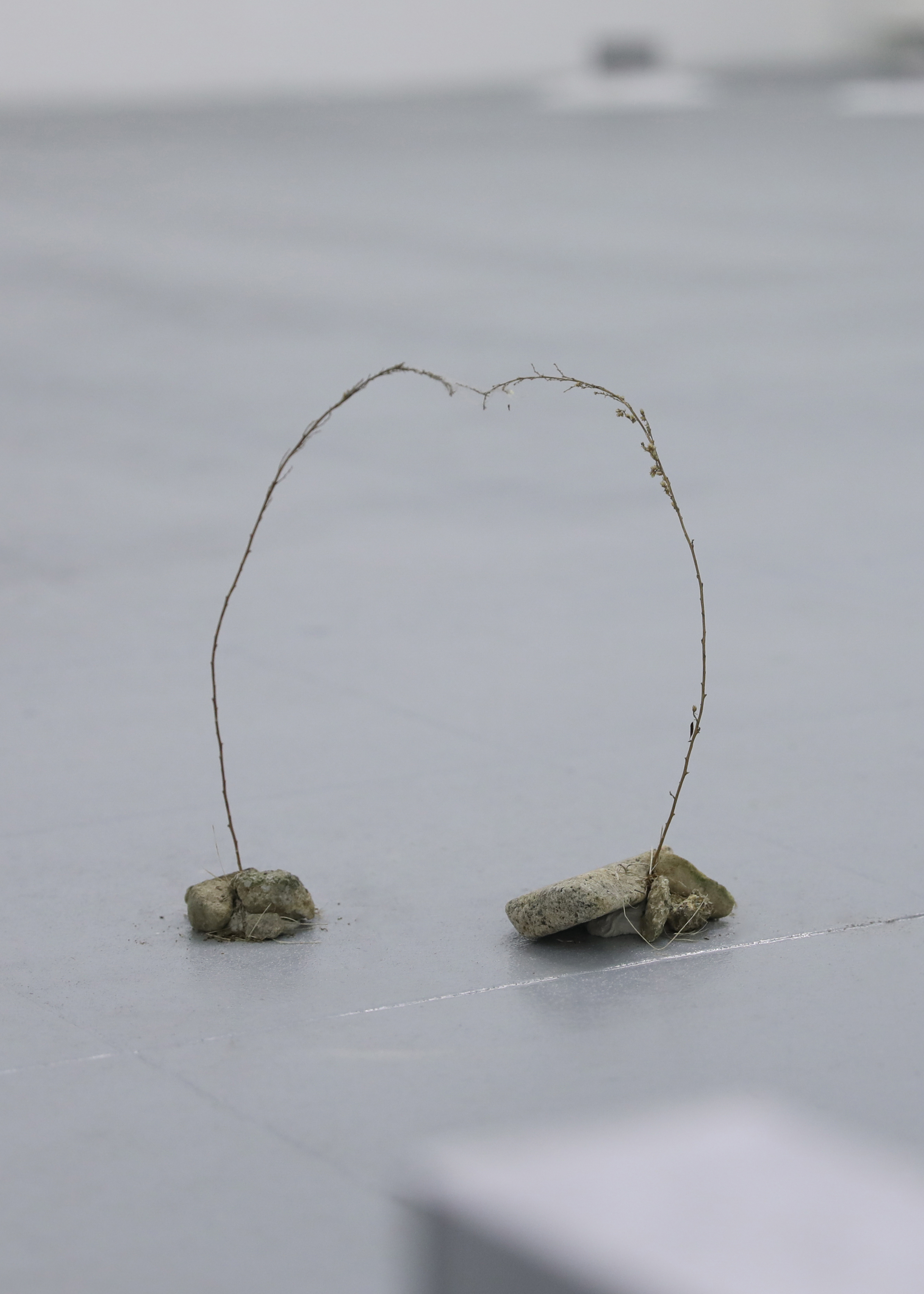
Thin lines of objects do not occupy a massive area, however, they deeply induce the perspective of beholders. In her artist interview, Euysun Kim said that she intended to make an object that sensitively reacts with its external environment. However, sensitivity does not necessarily associate a weakness of the object. Euysun argues that natural objects are the most sensitive and the most durable things which can be touched by her. There are gravity, friction, and air resistance among the branches that seem fragile. <Tangles> is an entanglement of roots, fibers, leaves, and seeds that were captured by the artist’s recognition. According to her interview, she did not use any glue or tape to connect each object. “Boundary of a leaf is rougher than our expectation, and seeds have hooks to be hitched somewhere. Roots and Stems have fine soft hair. Such parts can be entangled only with the texture of their surface or electrostatic force. The enmeshed objects are strongly attached just as the dirt on clothes cannot be easily removed. The volume and weight of blues or sticks were redundant for <Tangles>.”19
Without any adhesive, the organization of the objects does not restrictly bind the materials. Euysun questions, “How can I see the object as well as I can?” that becomes a core of her artmaking process. Her question is focused on the attitude of the observer to sense something, rather than an act of looking. Such deliberation can be extended to a question of the relationship of her objects and their audience. By contemplating in exhibition spaces almost for a week, she delicately plans the position, distance, movements of audiences, to induce them to a non-hierarchical perspective on objects. Whenever Euysun treats her materials, she intends to preserve the independence of her materials and liberate them from their use. The exhibited objects that had been detached from their utility and context, attract perceptions from various angles. In some aspects, the uselessness of the objects reminds the imagination of Brenda Shaughnessy’s poetry project titled <The Impossible Lesbian Love Objects>, which was dedicated to a work of Meret Oppenheim. “I’m not just an object, my surfaces servicing, but I’m no more than myself. I end at my edges, finish my points, even if I bend your senses.” Shaughnessy said that “It made me think about women’s sexuality—what is women’s sexuality when it’s not a utility? And that was an exciting direction.”20
In her essay titled <Queerly Made: Harmony Hammond’s Floorpieces>, Julia Bryan-Wilson quotes a word of Harmony Hammond to explain the notion of lesbian art. “I like to think of lesbian art as a braid with three strands, gender, sexuality, and art, though from time to time other stands, such as history or identity, are woven in and out.” According to her, The braid can be an excellent metaphor because the strands remain discrete, but the final braid is stronger than any one strand. In this context, Bryan-Wilson argues that <Floorpieces> of Harmony Hammond, the pieces of Hand-braided rag rugs, can be a third space of queerness. “Hammond’s Floorpieces literalize the metaphor of the rug as a secret place where dirt is gathered and hidden. The language of sweeping things “under the rug” activates a sense of domestic space and invisibility that is similar, perhaps, to the metaphor of the closet (also an enclosed, dark place where things are meant to be kept out of sight).”21
Regarding the concept of the third space of queerness, In my opinion, the gravitation among Euysun’s objects, with its tactility and sensitivity, can be analogized to a new dynamic of a lesbian genealogy. Loosened but strengthened enmeshment of the severed roots and stems creates atypical spaces in which invisible forces are making the non-linear connections. Rather than inheriting the metaphor of a closet, The work can become a new form of breathing space that has the more vibrant possibility which allows keen perceptions.
19 Louise the Women, Pipette for Louise: 03. Euysun Kim, online video recording, YouTube, 13 January 2021, <https://youtu.be/uOFofE9k_G4>
20 Brenda Shaughnessy, The Impossible Lesbian Obejct(s), Nov 5 2019, Museum of Modern Art <https://www.moma.org/magazine/articles/143>
21 Julia Bryan-Wilson (2009) Queerly Made: Harmony Hammond's Floorpieces, The Journal of Modern Craft, 2:1, 59-79,
DOI: 10.2752/174967809X416279
물체의 가느다란 선들은 넓은 면적을 차지하지 않지만, 관람자의 시점을 깊이 있게 유도한다. 작가 인터뷰에서 김의선은 자신의 작업이 외부 환경에 민감하게 반응하는 오브제가 되길 의도했다고 말했다. 그러나 ‘민감함’은 반드시 대상의 ‘약함’을 의미하지 않는다. 김의선은 자연물들이야말로 그녀가 손으로 만질 수 있는 것 중 가장 민감하면서도 가장 강인한 존재라고 말한다. 겉보기에 연약해 보이는 나뭇가지 사이에도 중력, 마찰력, 공기 저항이 작용한다.
〈Tangles〉는 작가의 인식에 의해 포착된 뿌리, 섬유, 잎, 씨앗 등의 얽힘이다. 그녀의 말에 따르면, 각각의 오브제를 연결하기 위해 어떠한 접착제나 테이프도 사용하지 않았다. “잎의 경계는 우리가 생각하는 것보다 거칠고, 씨앗은 어디엔가 걸리기 위한 갈고리를 가지고 있어요. 뿌리와 줄기에는 아주 미세한 털이 있죠. 이러한 부분들은 표면의 질감이나 정전기만으로도 엉킬 수 있습니다. 얽힌 오브제들은 옷에 묻은 먼지가 쉽게 떨어지지 않는 것처럼 단단히 붙어 있습니다. 〈Tangles〉에는 막대기나 덩어리의 부피와 무게가 오히려 불필요했어요.”19
어떠한 접착물도 없이 구성된 오브제의 배열은 재료를 단단히 구속하지 않는다. 김의선은 “어떻게 하면 사물을 최대한 잘 볼 수 있을까?”라는 질문을 던지며, 이를 작업의 핵심 과정으로 삼는다. 그녀의 질문은 ‘보는 행위’ 자체보다 ‘감지하려는 태도’에 집중되어 있다. 이러한 사유는 작품과 관람자 사이의 관계에 대한 질문으로 확장된다. 작가는 전시장에 머물며 거의 일주일 동안 공간을 숙고하고, 관람객의 위치, 거리, 움직임을 섬세하게 계획하여, 그들이 오브제를 위계 없이 바라보도록 유도한다.
김의선이 재료를 다룰 때마다 그녀는 그 재료가 본래의 용도에서 벗어나 독립적인 존재로 남기를 원한다. 그렇게 맥락과 기능에서 분리된 오브제들은 다양한 각도에서의 지각을 끌어낸다. 어떤 면에서 이러한 ‘쓸모없음’은 브렌다 셔그너시(Brenda Shaughnessy)의 시 프로젝트 〈The Impossible Lesbian Love Objects〉를 떠올리게 한다. 이 작품은 메레 오펜하임(Meret Oppenheim)의 작업에 헌정된 것으로, 시 속에서 셔그너시는 이렇게 말한다.
“나는 단순히 표면을 제공하는 오브제가 아니야. 하지만 나는 나 그 이상도 아니지. 나는 나의 끝에서 멈추고, 나의 모서리에서 마무리돼. 네 감각을 휘게 하더라도.”
셔그너시는 “이 작업을 통해 여성의 성적 주체성에 대해 생각하게 되었어요. 여성의 성이 ‘도구적’이지 않을 때, 그것은 어떤 형태일까? 그건 흥미로운 방향이었죠.”라고 말했다.20
줄리아 브라이언-윌슨(Julia Bryan-Wilson)은 〈Queerly Made: Harmony Hammond’s Floorpieces〉라는 글에서 하모니 해먼드(Harmony Hammond)의 말을 인용해 ‘레즈비언 예술’의 개념을 설명한다. “나는 레즈비언 예술을 세 가닥의 땋은 머리로 생각하곤 합니다. 성별, 섹슈얼리티, 예술이라는 세 가지 요소가 얽혀 있지만, 때때로 역사나 정체성과 같은 다른 요소들이 들어왔다 나가기도 하죠.” 그녀에 따르면 이 ‘땋기(braid)’는 훌륭한 은유이다. 각각의 가닥은 분리되어 있지만, 완성된 땋음은 어느 한 가닥보다 훨씬 강하기 때문이다. 이러한 맥락에서 브라이언-윌슨은 해먼드의 〈Floorpieces〉—손으로 짠 헝겊 러그 작품들—이 ‘퀴어니스의 제3의 공간’을 형성한다고 주장한다.
“해먼드의 〈Floorpieces〉는 러그(rug)를 비밀스러운 장소의 은유로 구체화합니다. 먼지가 모이고 숨겨지는 곳이죠. ‘러그 아래에 쓸어 넣는다’는 표현이 활성화하는 감각, 즉 가정적 공간과 보이지 않게 감춰진 것의 감각은 ‘벽장(closet)’의 은유—사물을 시선 밖에 두려는 어두운 밀폐 공간—와 유사합니다.”21
‘퀴어니스의 제3의 공간’이라는 개념에 관해, 필자는 김의선의 오브제들 사이의 중력과 촉각, 그리고 민감함이 새로운 레즈비언적 계보의 역동성으로 비유될 수 있다고 본다. 절단된 뿌리와 줄기의 느슨하지만 강한 얽힘은, 비가시적인 힘이 비선형적 연결을 만들어내는 비정형의 공간을 형성한다.
그녀의 작업은 ‘벽장(closet)’의 은유를 계승하기보다, 보다 생생하고 개방적인 ‘호흡의 공간’이 되어 예리한 감각과 인식의 가능성을 허용한다.
주석
19 Louise the Women, Pipette for Louise: 03. Euysun Kim, 온라인 영상, YouTube, 2021년 1월 13일, https://youtu.be/uOFofE9k_G4
20 Brenda Shaughnessy, The Impossible Lesbian Object(s), 2019년 11월 5일, Museum of Modern Art https://www.moma.org/magazine/articles/143
21 Julia Bryan-Wilson (2009) Queerly Made: Harmony Hammond's Floorpieces, The Journal of Modern Craft, 2:1, 59-79, DOI: 10.2752/174967809X416279